
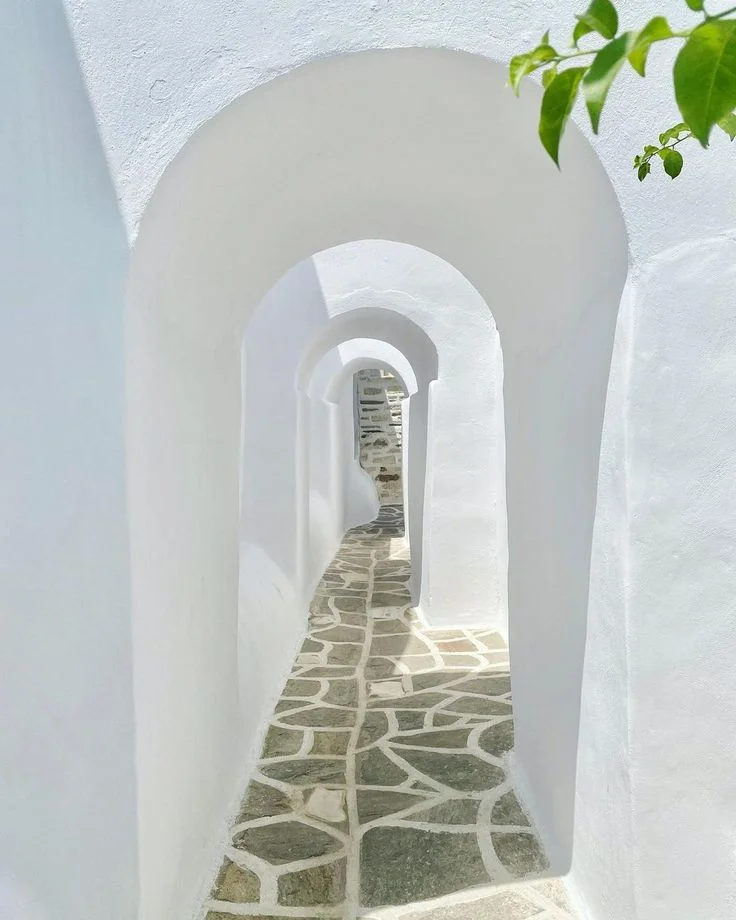
The whitewashed walls and blue domes of the Cyclades are far more than postcard imagery. They are the visible expression of a design philosophy refined over centuries by sun, wind, water scarcity, and communal life.
Across islands such as Paros, Santorini, Mykonos, Naxos, Tinos, Sifnos, Amorgos, Serifos, and Folegandros, architecture evolved not through formal schools or grand theories, but through the accumulated wisdom of generations responding to the same elemental forces. The result is one of the world’s most recognisable architectural languages: simple, sculptural, human-scaled, and remarkably contemporary in spirit.
Form Follows Function
The iconic cubic volumes of Cycladic houses were never conceived as stylistic gestures. Every element served a practical purpose:
Flat roofs collected precious rainwater in underground cisterns.
Thick stone walls provided natural thermal insulation, keeping interiors cool during the intense summer heat and retaining warmth in winter.
Small, deeply recessed windows minimised solar gain while protecting interiors from the fierce Meltemi winds.
Rounded corners helped reduce wind pressure and prevented erosion of the plaster surfaces.
What appears today as minimalist sophistication is, in fact, climate-responsive architecture at its purest.
One of the finest examples can be found in the traditional houses of Chora on Mykonos, where compact white volumes are tightly clustered together, creating a dense urban fabric that remains surprisingly comfortable even during the hottest months.
Paros: Marble, Villages, and Monasteries
Paros deserves to be understood not only through contemporary architecture, but through the richness of its historical built heritage.
At the heart of the island lies Lefkes, the former medieval capital. Built amphitheatrically on the hillside, the village is a masterpiece of Cycladic urbanism: marble-paved alleys, shaded archways, interconnected terraces, and whitewashed houses that seem to grow organically from the landscape. The subtle use of local Parian marble, in staircases, thresholds, fountains, and church details, gives Lefkes a refinement that distinguishes it from many other Cycladic settlements.
In Naoussa, the old fishermen’s quarter preserves a different architectural character. Low cubic houses, narrow passages, and small internal courtyards create an intimate relationship between sea, commerce, and daily life. The village remains a living example of how traditional Cycladic settlements balanced defence, climate adaptation, and social interaction.
Paros is also home to one of the most important religious monuments in Greece: the Panagia Ekatontapyliani in Parikia. Dating back to the 4th century, this extraordinary Byzantine complex combines monumental marble construction with the restrained geometry that would later influence Cycladic vernacular architecture. Its massive stone volumes, domes, courtyards, and finely carved architectural details reveal the island’s long-standing tradition of stone craftsmanship and sacred architecture.
Even beyond its villages, traces of Paros’s architectural heritage appear in its dry-stone agricultural terraces, dovecotes, rural chapels, and monastery compounds, all of which contribute to the island’s distinctive cultural landscape.
The Social Fabric of Village Design
Cycladic villages were designed as much for collective protection as for individual dwelling. Settlements such as Lefkes on Paros, Kastro on Sifnos, Chora on Amorgos, Pyrgos on Santorini, and Apiranthos on Naxos developed as intricate labyrinths of narrow alleys, vaulted passages, and interconnected courtyards.
These winding streets served several purposes:
confusing pirates during periods of frequent raids,
shielding residents from strong winds,
creating shaded public spaces that encouraged daily social interaction,
and preserving precious agricultural land by building vertically and compactly.
Walking through Lefkes, with its marble-paved alleys and cascading white houses, or through the steep passages of Kastro in Sifnos, one experiences architecture not as isolated objects but as a continuous communal landscape.
Santorini: Architecture Carved from the Volcano
Perhaps the most dramatic expression of Cycladic architecture is found on Santorini, where volcanic geology forced builders to adapt in extraordinary ways.
The famous cave houses (yposkafa) of Oia and Fira were excavated directly into the caldera cliffs. Their vaulted interiors maintain remarkably stable temperatures year-round, demonstrating an advanced understanding of passive environmental control long before modern sustainability became a design concern.
A particularly celebrated example is the Katikies complex in Oia, whose cascading white volumes seem to emerge organically from the volcanic rock itself. Rather than dominating the landscape, the architecture appears sculpted by it.
Amorgos: Monastic Architecture Between Sea and Sky
If Santorini represents architecture shaped by volcanoes, Amorgos embodies architecture shaped by cliffs and isolation.
The extraordinary Monastery of Panagia Hozoviotissa, suspended dramatically above the Aegean on a vertical rock face, is one of the most awe-inspiring buildings in the Cyclades. Founded in the 11th century, its narrow whitewashed structure rises almost impossibly from the cliff, demonstrating how Cycladic builders adapted to extreme topography with ingenuity and restraint.
The nearby Chora of Amorgos, with its windmills, fortified houses, and shaded stairways, remains one of the most authentic and least altered traditional settlements in the island group.
Sifnos: The Island of Refined Proportions
Sifnos has long been admired by architects for the exceptional harmony of its built environment.
The hilltop village of Kastro, once the island’s medieval capital, combines Venetian defensive architecture with traditional Cycladic forms. Houses are built wall-to-wall along the cliff edge, creating a continuous protective outer shell while opening onto intimate interior courtyards.
Equally remarkable is the Church of the Seven Martyrs, perched on a rocky promontory below Kastro. Its brilliant white silhouette against the deep blue sea has become one of the defining architectural images of the Cyclades — a perfect example of how simplicity, proportion, and setting can create extraordinary visual power.
Serifos and Folegandros: Raw Minimalism
Less celebrated internationally but deeply influential in contemporary architectural discourse are Serifos and Folegandros.
The Chora of Serifos climbs steeply up a barren hillside, its cubic houses appearing almost like geological formations emerging from the rock. The absence of excessive ornament gives the settlement a strikingly modern, almost abstract character.
On Folegandros, the medieval Kastro quarter preserves a rare sense of enclosure. Narrow covered passages, shared walls, and tiny shaded squares create an architecture of intimacy and protection, where the boundary between private and public space remains beautifully fluid.
Tinos: Where Marble Becomes Architecture
While most Cycladic islands are associated with white plaster, Tinos introduces another essential dimension: marble craftsmanship.
The village of Pyrgos, birthplace of renowned sculptors such as Giannoulis Chalepas, features houses adorned with intricately carved marble doorframes, fountains, balconies, and lintels. Here, architecture becomes a dialogue between vernacular building traditions and fine sculptural art.
This tradition resonates strongly with the historical use of Parian marble, which was prized in antiquity for some of the most celebrated sculptures of the ancient Greek world.
Contemporary Echoes of a Vernacular Tradition
Today’s architects across the Cyclades continue to draw inspiration from this vernacular heritage. The most successful contemporary homes do not simply imitate white cubes; they reinterpret enduring principles:
fragmented volumes that follow the natural contours of the terrain,
stone walls that echo ancient agricultural terraces,
shaded courtyards and pergolas that extend living spaces outdoors,
natural materials such as marble, limestone, wood, and lime plaster,
and a constant attention to light, wind, and orientation.
Whether on Paros, Sifnos, Amorgos, or Tinos, the strongest contemporary architecture remains rooted in a deep respect for place, craftsmanship, and landscape.
Lessons for Contemporary Design
What makes Cycladic architecture so relevant today is its extraordinary alignment with many principles now associated with sustainable and bioclimatic design:
passive cooling,
local materials,
compact urbanism,
durable construction,
water management,
and a strong connection between indoor and outdoor living.
Long before sustainability became a global imperative, the builders of the Cyclades had already developed an architecture that was resource-conscious, climate-adapted, and emotionally resonant.
A Living Architectural Legacy
Cycladic architecture endures because it achieves something rare: it is simultaneously humble and monumental. A simple white cube, shaped by necessity and illuminated by the Aegean light, can possess a sculptural power equal to that of far more elaborate buildings.
From the marble villages of Paros to the cliffside monastery of Amorgos, from the fortified Kastro of Sifnos to the volcanic cave houses of Santorini, the Cyclades reveal an astonishing diversity hidden beneath their seemingly unified whitewashed aesthetic.
For visitors, homeowners, and architects alike, these islands offer more than beautiful scenery. They offer a timeless lesson in how simplicity, proportion, material honesty, and respect for place can create spaces that remain meaningful across centuries.
In an age of ever-changing architectural trends, the Cyclades remind us that true elegance is often born not from excess, but from a profound understanding of light, climate, landscape, and the rhythms of human life.
