When we first arrived on Paros in 2011, the island was already loved by those who knew it. But it was not yet the international real estate destination it is today. There were fewer villas. Fewer large-scale developments. Fewer international buyers. Property changed hands through personal relationships, local networks and word of mouth. More than a decade later, the landscape is very different. Paros has become one of the most sought-after islands in the Cyclades, attracting buyers from across Europe, the Middle East, North America and beyond. Yet the most interesting thing about the Paros property market is not simply that prices have risen. It is how the market has changed, and what that change tells us about the future of the island.
From Holiday Island to Lifestyle Destination
The first major shift has been in the type of buyer coming to Paros. The traditional international buyer often came looking for a holiday house: somewhere beautiful to spend a few weeks each summer. Today, the motivations are much broader. Some buyers want a second home that can become a primary residence later in life. Others are looking for a long-term investment. Some are entrepreneurs who can work remotely and want to spend several months a year on the island. There are families looking for a place where their children can grow up with a connection to Greece, and experienced international property owners looking for something more personal after having already owned homes in Mykonos, Santorini or other Mediterranean destinations.
The common denominator is that Paros is increasingly being viewed not simply as a holiday destination, but as a place to live. That distinction matters. A buyer looking for a holiday house might prioritise a swimming pool and a spectacular sea view. Someone imagining a life on the island will also ask: Where is the nearest year-round village? Can I walk to a bakery? What is the road like in winter? Where are the schools? Who will look after the house? What happens outside July and August? Those questions are changing the property market.
Paros Is Not One Market
One of the most important things we tell buyers is that there is no single “Paros property market.” There are several. The island's geography, landscape and villages create very different micro-markets, each with its own character and buyer profile.
Naoussa and the Northeast
Naoussa remains one of the island's strongest international addresses. The combination of the traditional fishing port, restaurants, nightlife, beaches and proximity to the north coast makes it particularly attractive to buyers who want to be close to the energy of the island. Properties within walking distance of Naoussa command a premium, particularly when they combine privacy with genuine proximity to the village. But Naoussa is also where buyers need to be particularly discerning. A property described as “near Naoussa” can mean very different things depending on the exact location, access, views, privacy and surrounding development. On Paros, a few kilometres can make a significant difference in both lifestyle and value.
Parikia and the West
Parikia has historically been more understated than Naoussa, but that is changing. As the island's main port and year-round administrative centre, it has a particularly strong connection to everyday life on Paros. The area offers something increasingly valuable: year-round functionality. Traditional houses in the old town, properties overlooking the bay and homes within easy reach of the town centre appeal to buyers who are interested in spending more time on the island outside the traditional summer season. For us, Parikia is a good example of why the future of Paros cannot be understood simply through the lens of holiday tourism.
The Southeast: Aliki, Faragas, Drios and Beyond
The southern and southeastern coast offers a very different proposition.
Here, buyers are often attracted by space, beaches, agricultural landscapes and a slower rhythm. Areas around Aliki, Aspro Chorio, Drios and the surrounding countryside can offer larger plots and a stronger sense of privacy than the more established northern destinations. The proximity to some of Paros's most beautiful beaches is an obvious attraction. But there is another reason these areas deserve attention: they still offer opportunities to acquire properties where the relationship between land, architecture and landscape remains central.
Lefkes and the Interior
Our own base in Lefkes gives us a particular affection for the interior of the island.
The mountain villages offer something the coastal markets cannot easily reproduce: authentic year-round life. Traditional architecture, agricultural land, stone walls, old paths and a cooler summer climate create a very different atmosphere. For buyers interested in character rather than proximity to the beach, villages such as Lefkes or Kostos can be particularly compelling. They are not necessarily the obvious choice for a first-time visitor. But that is precisely what makes them interesting.
The Scarcity Factor
One of the fundamental characteristics of the Paros market is simple: there is only so much Paros. Land is finite. The island's most desirable landscapes are finite. Properties with unobstructed sea views, meaningful privacy, good access and proximity to established villages are even more limited. And genuinely exceptional properties are rarer still. This is why we don't believe the market can be understood simply by looking at the average price per square metre. A 150-square-metre house on a small plot near a busy road is not equivalent to a 150-square-metre house surrounded by mature olive trees, with uninterrupted views, architectural character and access to a beautiful beach. On Paros, land, location, orientation, views, privacy, architecture and planning potential can change the value of a property dramatically. The best properties are not commodities.
The Rise of New Cycladic Architecture
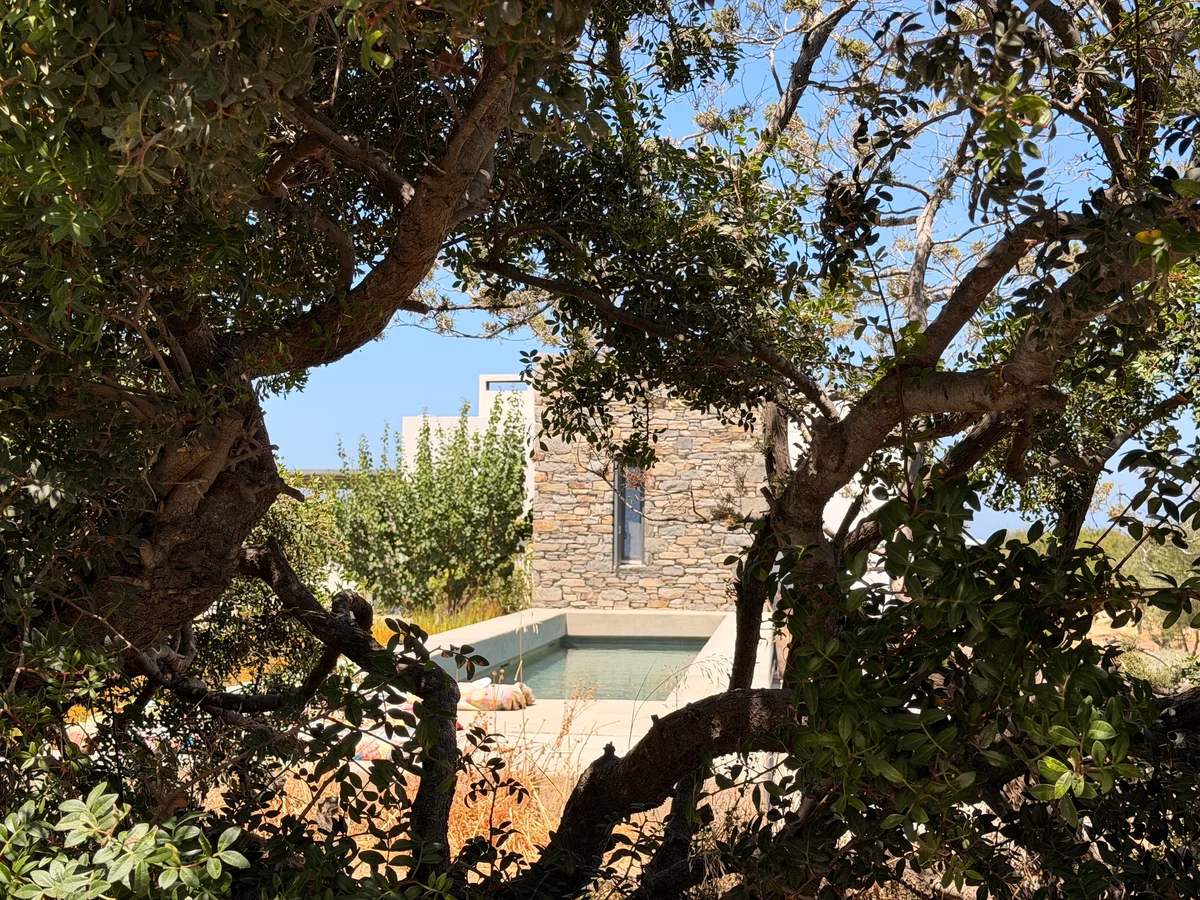
Another important change is architectural. Paros is experiencing a new generation of construction that combines traditional Cycladic principles with contemporary architecture. Stone walls, local materials, fragmented volumes and courtyards are being reinterpreted alongside large openings, contemporary interiors, pools and sophisticated energy systems. When done well, this can produce extraordinary homes. But the quality varies enormously. The increase in construction also raises an important question for the island: How much development can Paros absorb without losing the qualities that made people want to come here in the first place? For us, this is not simply an environmental question. It is also a real estate question. A landscape that becomes overdeveloped eventually loses part of its value. The most desirable properties of the future will increasingly be those that offer architecture, privacy and connection to the landscape without feeling disconnected from it.
What International Buyers Should Know
Buying property in Greece is not the same as buying property in London, Paris or Geneva. The process involves different legal, planning and technical considerations, and the reality of each property can be more complex than the photographs suggest. For international buyers, due diligence is therefore essential. We encourage buyers to investigate:
Title and ownership
The legal status of the property and land must be carefully verified.
Planning and building history
Existing buildings, permits, extensions and the legality of structures should all be reviewed.
Access
A beautiful property is of limited value if access is problematic. Public roads, private roads and rights of way matter.
Boundaries and land classification
Particularly when purchasing larger plots, the exact status and boundaries of the land are crucial.
Utilities and infrastructure
Water, electricity, internet, waste management and road access can vary considerably depending on location.
Future surroundings
What you see from the terrace today is not necessarily what will remain there forever. Understanding the planning context around a property is essential.
A good property search therefore involves much more than finding a beautiful house.
It involves understanding what you are actually buying, and being properly accompanied throughout the process. In Greece, this typically means working with both a knowledgeable local agency and an independent lawyer who can ensure that every stage, from initial due diligence to final transfer, is handled with clarity, security and full transparency.
The New Buyer Is More Discerning
One of the changes we have noticed most clearly is the sophistication of international buyers. Today's buyer often arrives with extensive research already completed. They know the Cyclades. They have visited several islands. They understand the differences between Paros, Mykonos, Antiparos, Sifnos or Kea. They are less interested in generic “luxury” and more interested in authenticity, architecture, privacy and quality. They want a house that feels connected to its location. They increasingly care about sustainability, water consumption, energy efficiency and the relationship between a building and its landscape. In other words, the market is becoming more mature. And that is a positive development.
Where Do We See Opportunity?
After years of working on the island, we believe the most interesting opportunities are not necessarily the properties that attract the most attention online. They are often found in the spaces between established markets. Properties with genuine character. Larger plots in carefully chosen locations. Traditional houses that can be restored intelligently. Contemporary architecture with a strong relationship to its surroundings.
Properties close enough to a village to be convenient, but far enough away to retain privacy. And increasingly, homes that can function beyond the traditional summer season. The best opportunities are rarely about buying the cheapest property. They are about identifying what will remain desirable when the market changes again.
Looking Beyond Paros
Paros has taught us an enormous amount about island real estate. But it has also taught us that every Cycladic island has its own logic. This is one of the reasons our work has gradually expanded beyond Paros. Today we represent selected properties in Ios, Kea, Kythnos, Mykonos, Santorini, Serifos, Sifnos and Syros, responding largely to the needs and requests of our existing clients. After years of working deeply within one island, we felt ready to share that experience more widely. The opportunity is not to create another generic “Greek islands” property portfolio. It is to understand the individual character and market dynamics of each island. Because the right property for one buyer may be completely wrong for another.
What We Expect from the Next Chapter
We don't believe Paros is finished changing. Quite the opposite.
International demand will continue to evolve. Construction will continue. Infrastructure will improve. New areas will emerge. Some locations will become increasingly established, while others may remain deliberately quieter.
The challenge will be maintaining a balance between growth and preservation. For us, that balance is not an abstract idea. It is directly connected to the value of the properties we represent and to the future of the island we call home. The most resilient part of the Paros market, in our view, will be the segment that offers something genuinely difficult to reproduce: a beautiful place, a well-considered property, a strong sense of privacy, and a meaningful connection to the landscape.
Those qualities cannot be manufactured at scale.
And that is precisely why they matter.
Our Perspective
We have been watching the Paros property market evolve since 2011. We have seen the island become more international, more sophisticated and more valuable. We have also seen how quickly things can change. Our role is not to predict exactly where prices will be five years from now. It is to understand why a property has value today, what could influence that value tomorrow, and whether the two are aligned. That is the perspective we try to bring to every property we represent and every buyer we advise.
Because ultimately, buying a home in the Cyclades is not simply a financial decision.
It is a decision about place, time and the kind of life you want to build around them.
And that is where real estate becomes much more interesting.
This article reflects the perspective of Paris London Paros International Real Estate based on our experience working in the Paros property market since 2018. It is intended as market commentary rather than financial or legal advice.